
A slicer is the program that turns your 3D model into the thousands of instructions your printer actually follows. It decides how thick each layer is, how fast the nozzle moves, where supports go, and a few hundred other things you can happily ignore right up until the moment you cannot.
Slicing is the one step that still needs a computer on most printers. Our guide to whether you need a computer for a 3D printer covers the phone-app and cloud slicing options.
It is also the piece of the workflow people think about least and fight with most. The printer gets blamed for problems the slicer caused.
Here is what people are genuinely using in 2026, who each one suits, and where each one becomes annoying.
Slicer comparison at a glance
| Slicer | Cost | Best for | Watch out for |
|---|---|---|---|
| OrcaSlicer | Free, open source | Anyone who wants to tune a printer properly | More settings on screen than a beginner needs |
| Cura | Free, open source | Beginners, and anyone with an unusual printer | Can feel sluggish on older computers |
| PrusaSlicer | Free, open source | Prusa owners, and organic supports | Profiles for other brands take setup |
| Bambu Studio | Free | Bambu Lab printers, especially with the AMS | Built around Bambu hardware first |
| Lychee Slicer | Free, with a paid Pro tier | Resin printing and difficult supports | The useful features sit behind Pro |
| Chitubox | Free, with a paid Pro tier | Resin, and it ships with many resin printers | The free version is deliberately limited |
| Simplify3D | Paid licence | People who want support control and will pay for it | Hard to justify now the free options are this good |
OrcaSlicer
Best for: getting a printer properly dialed in.
OrcaSlicer started life as a fork of Bambu Studio, which itself came from PrusaSlicer, so it inherits a decade of work from both. What it added is the reason to use it: calibration tests built directly into the software. Flow rate, pressure advance, temperature towers and retraction tests are a couple of clicks away instead of files you hunt down and import.
If you have ever wondered why your prints are almost right, this is the tool that tells you. It supports a wide range of printers, not just Bambu machines.
The trade is that it puts a lot on screen. A complete beginner will find it busy.
Cura
Best for: starting out, and for printers nobody else supports.
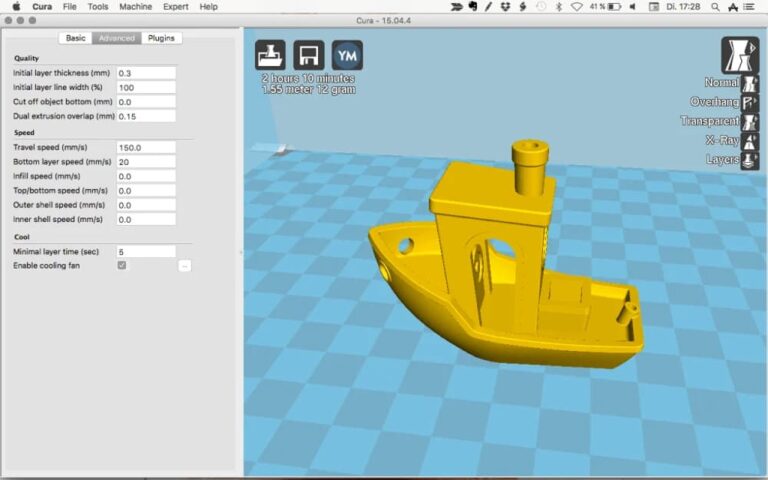
Cura is made by UltiMaker and has been the default answer for years, for good reason. It is free, it is genuinely straightforward in its basic mode, and its library of printer profiles is the largest of any slicer. If you own something obscure, Cura probably already knows about it.
There is also a plugin marketplace, which is where a lot of its long tail usefulness lives.
The complaint you will hear most is speed. On an older laptop, slicing a large or detailed model takes its time.
PrusaSlicer
Best for: Prusa owners, and anyone printing organic shapes.
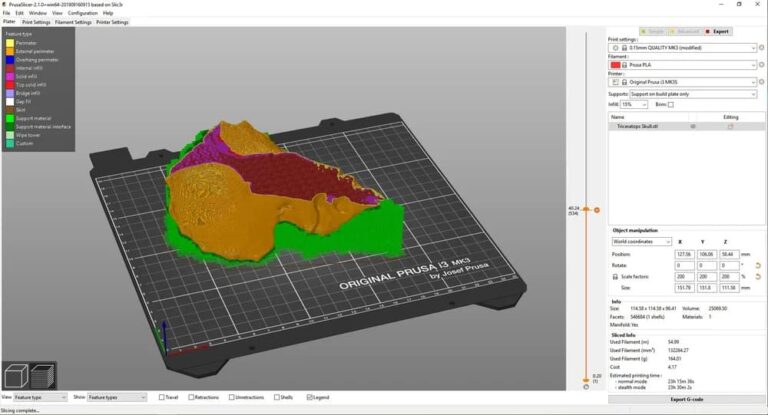
PrusaSlicer is Prusa Research’s own slicer, descended from the original Slic3r project. Its organic supports are the feature people switch for: tree like structures that hold up overhangs while touching the model as little as possible, which makes them far easier to remove.
It is free and open source, and it is the codebase most other modern slicers are built on. If you own a Prusa it is the obvious choice. If you do not, you can still use it, but expect to spend time on the printer profile.
Bambu Studio
Best for: Bambu Lab printers.
Bambu Lab built this on PrusaSlicer and tuned it around their own hardware. If you own a Bambu machine, particularly with the AMS multi material unit, this is the path of least resistance. Filament swaps, colour changes and the printer’s own features are handled without you configuring anything.
It works with other printers, but the further you get from Bambu hardware the less reason there is to choose it over OrcaSlicer, which came from this codebase and went further.
The two resin slicers
Resin printing is a different job and the FDM slicers above are not built for it. Two options own this space.
Lychee Slicer is the one people reach for when supports are the problem. Its automatic support generation is the strongest available, which matters enormously in resin where a failed support means a failed print. There is a free tier and a paid Pro tier, and several of the features you will end up wanting are in Pro.
Chitubox ships bundled with a lot of resin printers, so many people meet it first. It does the job, and the free version is limited in ways that are clearly designed to move you to Pro.
If you are choosing rather than inheriting, try Lychee first. More on the technology itself in our guide to how resin printing works.
Simplify3D, the paid option
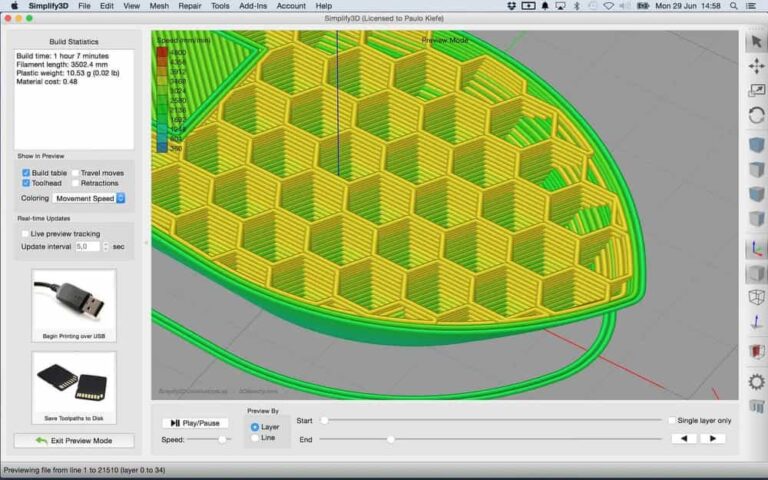
Simplify3D was the slicer people paid for when the free ones were rough. Version 5 arrived in 2022 and brought it back into contention, and its support editing is still excellent: you place and remove supports manually, exactly where you want them.
The honest position is that the free slicers have closed most of the gap. Buy it if manual support control is worth a licence fee to you. Do not buy it expecting a jump in print quality over OrcaSlicer.
What we no longer recommend
This page used to recommend several of these. Software moves, and a slicer list that does not move with it is worse than no list at all.
- Slic3r. The original open source slicer and the ancestor of PrusaSlicer, OrcaSlicer and Bambu Studio. Historically important, superseded by its own descendants.
- MatterControl. Development has effectively stopped. Use PrusaSlicer instead.
- MakerBot Print. The old desktop app. MakerBot moved its workflow to CloudPrint.
- Netfabb. Autodesk software aimed at industrial mesh repair and build preparation, on a subscription to match. Real capability, wrong tool for a desktop printer.
One correction worth making. Earlier versions of this page listed OctoPrint as a slicer. It is not one. OctoPrint is printer host software: it runs on a small computer next to your printer and lets you send jobs, watch a camera and control the machine remotely. It is genuinely useful and worth running. It just does not slice anything.
So which one should you install?
- First printer, want it to just work: Cura.
- Want to actually tune the machine: OrcaSlicer.
- You own a Prusa: PrusaSlicer.
- You own a Bambu Lab: Bambu Studio.
- You print resin: Lychee Slicer.
- You want manual support control and will pay: Simplify3D.
They are nearly all free. Installing two and comparing the same model in both costs you an evening and tells you more than any article can.
Common questions
What is the best free slicer for 3D printing?
For most people, Cura or OrcaSlicer. Cura is the easier start and supports the widest range of printers. OrcaSlicer gives you more control and the built in calibration tools. Both cost nothing, so the real answer is to try both.
Is OrcaSlicer better than Cura?
For tuning a printer, yes. The calibration tests built into OrcaSlicer solve problems Cura leaves you to diagnose yourself. For a beginner who wants to print something today, Cura is friendlier and its profile library is larger.
Can I use Bambu Studio with a printer that is not a Bambu?
Yes, it supports other printers. Whether you should is another question. Bambu Studio is tuned around Bambu hardware, and OrcaSlicer came from the same codebase with broader support and more tuning tools. On a non Bambu machine, OrcaSlicer is usually the better pick.
Do I need to pay for a slicer?
No. The strongest FDM slicers available in 2026 are free and open source. Paid tools like Simplify3D solve specific problems, mainly manual support placement. Start free and only pay once you know what is missing.
Is OctoPrint a slicer?
No. OctoPrint is printer host software for sending jobs and monitoring prints remotely. It can trigger a slicer, but it does not slice models itself. You still need one of the slicers above.
Can I use the same slicer for FDM and resin?
In practice, no. The two processes need different things from the software, and the FDM slicers do not handle resin supports or exposure settings. Use an FDM slicer for filament and Lychee or Chitubox for resin.
Keep reading
- How to improve 3D printer speed. Every setting that changes print time lives in the slicer you just picked.
- Print quality troubleshooting guide. Most print faults are slicer settings, not broken hardware.
- How FDM printing works. What the slicer is actually instructing the printer to do.
- How resin printing works. Why resin needs its own software.
- How to prepare files for 3D printing. What to do before the model reaches the slicer.
- Where to find 3D models. Free and paid printable files.
2 Responses