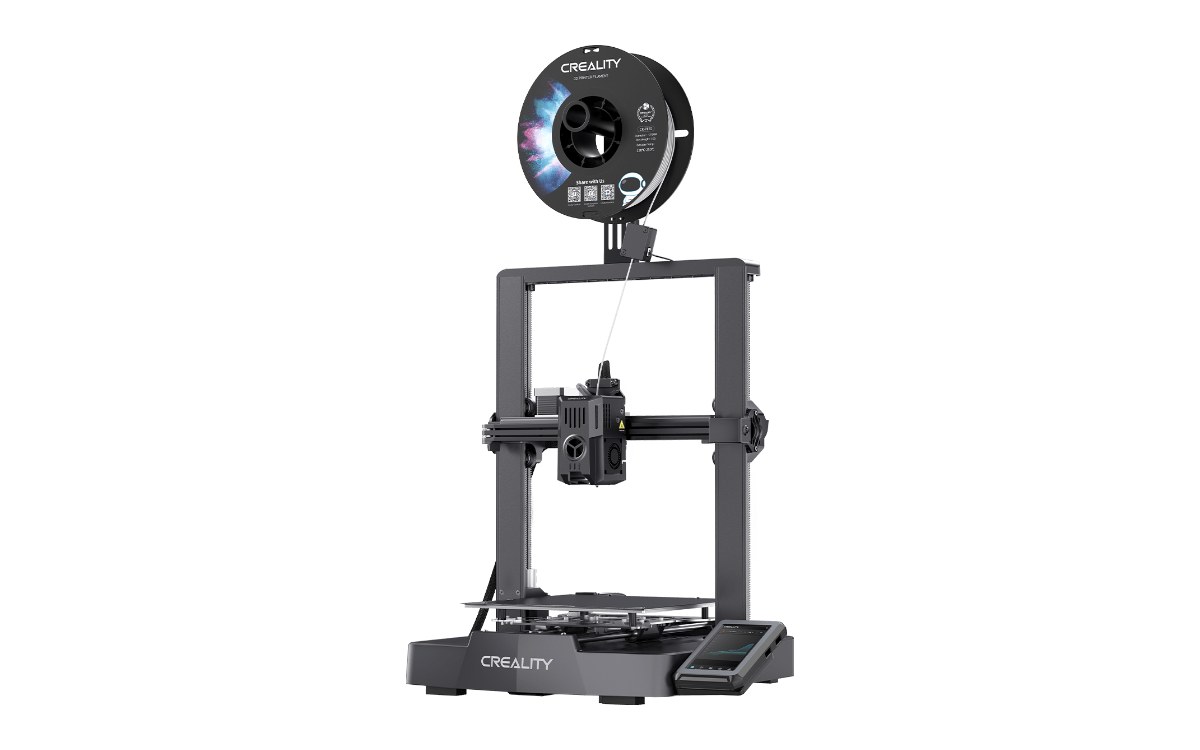
Both printers sit under $300, both target beginners, and both show up in the same searches. The Ender 3 V3 KE was Creality's entry-level machine until Creality discontinued it: larger build plate, direct drive Sprite extruder, faster top speed. Its replacement is the Ender-3 V4 Combo. The Bambu Lab A1 Mini is Bambu's compact machine: smaller footprint, quieter, more automated, and upgradeable to 4-color printing with the AMS Lite add-on.
Neither is the wrong printer. They are built for different buyers, and this page exists so you can tell which one is you.
[ QUICK VERDICT ]
The V3 KE wins on build volume. The A1 Mini wins on out-of-box experience and multicolor upgrade path.
Pick the V3 KE if
You want more build space
Pick the A1 Mini if
You want quieter printing and a multicolor path
Quick Answer
V3
Pick the Ender 3 V3 KE if you want a bigger 220 x 220 x 240 mm build plate, up to 500 mm/s top speed, and single-color printing. Also the right choice if you need TPU flexible filament support out of the box.
A1
Pick the Bambu Lab A1 Mini if desk space is tight, you want a quieter and more automated experience, and you want to upgrade to 4-color printing later by adding the AMS Lite ($459 total for the combo).
--
Pick neither yet if you need a build volume larger than 220 x 220 mm, or if you need TPU printing with multicolor at the same time.
Specs Compared
Spec
Creality Ender 3 V3 KE
Bambu Lab A1 Mini
Price (standalone)
Discontinued
$299 standalone / $459 with AMS Lite
Build volume
220 x 220 x 240 mm
180 x 180 x 180 mm
Max print speed
500 mm/s (Creality spec)
500 mm/s (Bambu spec)
Extruder
Sprite Direct Drive
Direct drive
Auto bed leveling
CR Touch, hands-free
Full-auto calibration
Multicolor printing
No
Yes, with AMS Lite (up to 4 colors)
Noise
Silent mainboard; not independently rated
Under 48 dB silent mode (Bambu spec)
Screen
4.3-inch color touchscreen
2.4-inch touchscreen
Connectivity
USB, LAN, Creality Cloud app
Wi-Fi, built-in camera, Bambu app
Max nozzle temp
300 C
300 C
Max bed temp
100 C
80 C
Materials
PLA, PETG, ABS, ASA, TPU
PLA, PETG, TPU ideal; ABS/ASA not recommended through AMS
Recall history
None reported
Full-size A1 (not Mini) recalled in 2024 for heatbed cable defect. A1 Mini not affected.
Prices change. Confirm the current price on the maker's store before buying.
Who the Ender 3 V3 KE is Best For
Image: Creality
The V3 KE replaced the Ender 3 V3 and has since been discontinued itself. It kept the same beginner positioning and added the Sprite direct drive extruder and hands-free auto leveling via CR Touch. It runs FDM printing like every machine on this page.
Best for
+220 x 220 x 240 mm build volume for bigger single-part prints
+Single-color printing, no AMS complexity
+TPU flexible filament support out of the box
Falls short on
-Discontinued: no longer sold new
-No multicolor path at any price
-Software ecosystem less polished than Bambu Studio
-More user setup required vs A1 Mini plug-and-play
-No built-in camera for remote monitoring
Who the Bambu Lab A1 Mini is Best For
The A1 Mini is Bambu's compact entry machine. It prints well from the first job and is built around a polished ecosystem: Bambu Studio slicer, Bambu Handy app, and optional AMS Lite for multicolor when you're ready. Both slicers get a full comparison in our slicer software guide.
+Real upgrade path to 4-color without switching printers
+Built-in camera for remote monitoring via app
Falls short on
-Smallest build volume: 180 x 180 x 180 mm
-$299 base; AMS Lite combo pushes to $459
-AMS Lite not rated for TPU; print without it for flexible filament
-AMS Lite adds significant desk space and generates waste on color changes
Frequently Asked Questions
Is the Ender 3 V3 KE different from the Ender 3 V3?
Yes. The V3 KE replaced the Ender 3 V3 and uses the Sprite direct drive extruder with similar speed specs. Both are now discontinued. Creality's current model in this line is the Ender-3 V4 Combo. Source: Creality Official Store.
Was the Bambu Lab A1 Mini recalled?
No. Bambu Lab and the CPSC recalled the full-size Bambu Lab A1 in 2024 for a heatbed cable defect. The A1 Mini is a separate model and was not part of that recall. Source: Bambu Lab's official recall page.
Can the A1 Mini print multiple colors without the AMS Lite?
No. Without the AMS Lite it prints one color per job. The AMS Lite adds 4-color printing and is sold separately, bringing the combo to $459. Source: Bambu Lab product page.
Can the Ender 3 V3 KE print flexible filament (TPU)?
Yes. Creality lists TPU among supported materials alongside PLA, PETG, ABS, and ASA. The Sprite direct drive extruder handles flexible filament without the feeding issues of a Bowden setup. Source: Creality spec sheet.
Which is better for beginners?
Both are beginner-targeted. The A1 Mini demands less setup effort out of the box. The V3 KE takes more initial calibration but gives you a larger build volume and more material flexibility. See our best 3D printers for beginners guide for the wider shortlist.
Which slicer software do they use?
The A1 Mini works best with Bambu Studio. The V3 KE works with Creality Print and is also compatible with popular third-party slicers including OrcaSlicer and Cura. Full comparison in our slicer software guide.
Bottom Line
The V3 KE offered more build volume at a lower entry price, but Creality has discontinued it. The A1 Mini gives you a quieter, more self-contained experience and a multicolor upgrade path. If you want both a large build plate and multicolor in one machine under $300, neither fits. The decision is about which tradeoff matches your actual use case.
Affiliate disclosure: if you buy through links on this page we may earn a commission at no extra cost to you. We do not own or test the printers on this site. See How We Research.
The Ender-3 V3 KE is discontinued. Creality has replaced it with the Ender-3 V4 Combo. For less money, the Ender-3 V3 SE is $179. It is slower (250 mm/s against the KE's 500 mm/s), so it is a step down, not a swap.
Specs and pricing sourced from Creality's and Bambu Lab's official product pages, Tom's Hardware's published review, and Bambu Lab's official recall notice. No printer on this site has been tested, measured, or owned by the Get 3D Printer team. See How We Research.